


A campaign can have a clear message and still spark a very different conversation.
That’s what makes Equinox’s latest global campaign, Question Everything But Yourself, such an interesting case study. The strategy behind it was carefully explained by both the brand and its creative agency. Yet much of the public conversation centered on something else entirely.
What Equinox Was Trying to Say
Created with creative agency Angry Gods, the campaign uses surreal AI-generated imagery to reflect a world where the line between reality and fiction is becoming increasingly blurred. The message encourages people to question the content they consume online while trusting something AI can't manufacture: the discipline, effort, and humanity behind physical fitness.
The agency said the strange visuals were intentional. Rather than creating polished AI images, they wanted work that felt "chaotic, uncanny, funny, disturbing, and deeply confusing," mirroring today's AI-saturated internet.
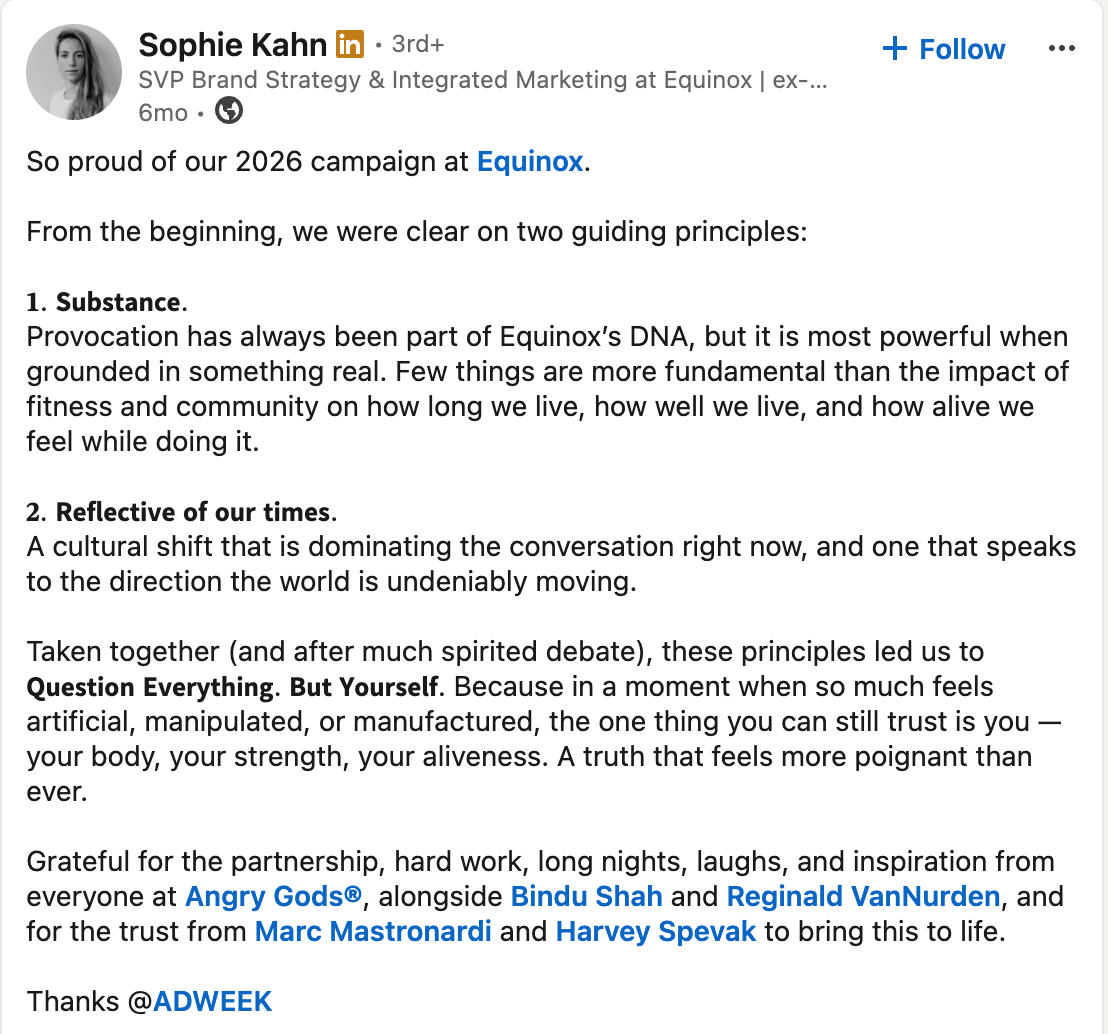
Equinox's Senior Vice President of Brand Strategy, Sophie Kahn, reinforced that thinking in a LinkedIn post. She explained that the campaign was built around two principles: substance and being reflective of our times. While provocation has long been part of the brand's identity, she argued that it's most meaningful when grounded in something real, particularly community and authentic human experience.
On paper, the strategy makes sense. The campaign uses artificial imagery to remind people of something undeniably human.
Why One Poster Changed the Conversation
Among the campaign's many AI-generated visuals, one image quickly became the focus of criticism: a poster depicting the AI-generated, disembodied head of an Asian woman being held like a robotic object. Instead of sparking conversations about AI-generated media, the image prompted criticism from Asian creators and community members, many of whom described it as dehumanizing and objectifying.

As criticism spread across social media, some creators said they raised their concerns directly with local Equinox gyms. The company reportedly reached out to creators through direct messages, explaining the campaign's intent and confirming that the image would be removed. At the time of writing, the poster had been removed.
That reaction also needs some context. In their study, “Racialized Sexism/Sexualized Racism: A Multimethod Study of Intersectional Experiences of Discrimination for Asian American Women,” Mukkamala and Suyemoto (2018) found that Asian women have long faced stereotypes portraying them as exotic, submissive, passive, or sexually available. Their research also shows how race and gender can overlap in shaping how Asian American women are perceived.
Scholars describe techno-orientalism as a way of imagining Asia and Asian people through technology, often portraying them as robotic, futuristic, or less fully human (Roh et al., 2015). More recently, Lok Siu and Catherine Chun (2020) argued that these narratives continue to shape how Asian people are perceived in conversations about technology, surveillance, and artificial intelligence.
Put more simply, the concept reminds us that people don't see every AI image the same way. For many Asian viewers, this wasn't just another surreal AI visual. It echoed familiar stereotypes that have existed long before generative AI entered the picture.
When Intent Meets Interpretation
This is where the campaign becomes especially interesting.
Equinox wanted people to think about AI and authenticity. Many viewers, meanwhile, focused on the symbolism of one image and the cultural meanings attached to it. By the time the company explained its intentions, people had already formed impressions based on what they had seen.
This situation is not unique to Equinox. Most people don’t experience campaigns through strategy decks, agency presentations, or LinkedIn posts. We experience the finished work, bringing our own experiences, cultural memory, and lived realities with them.
When those interpretations differ from a brand’s intended message, the conversation can quickly shift. The question is no longer what the campaign was designed to say, but what we believe it ultimately communicated.
And there is still a question we can’t really answer from the outside: why this particular image?
We can explain what Equinox and Angry Gods said they were trying to accomplish. We can look at the cultural context surrounding the image and understand why some audiences interpreted it differently. But unless the people behind the creative explain why they made that specific choice, we shouldn’t assume we know what motivated it.
Maybe that's the bigger takeaway here. As AI becomes more common in advertising, brands won't just need to think about what they want to say. They'll also need to think about the histories, experiences, and assumptions audiences bring when they see it.
Equinox wanted people to question what they saw online. Instead, many people questioned the campaign itself.
Maybe that's a reminder that in communications, intent is only half the story.
What do you think?
Should campaigns be judged by what brands intend to communicate or by how audiences ultimately interpret them?
And as AI-generated imagery becomes more common in advertising, how should brands account for the cultural histories and lived experiences that shape the way people see their work?
For more exciting articles, keep in touch and stay connected by following us on our socials Facebook, Instagram, LinkedIn, and Tiktok and we’ll make sure you’re updated!
References
Angry Gods. (2026). Equinox questions everything except the human body in provocative AI-led campaign. Little Black Book. https://lbbonline.com/news/equinox-2026-brand-campaign-AI
Kahn, S. (2026, July). So proud of our 2026 campaign at Equinox... [LinkedIn post]. LinkedIn. https://www.linkedin.com/posts/sophiekahn_so-proud-of-our-2026-campaign-at-equinox-ugcPost-7415413210956132353-ALcs/
Mukkamala, S., & Suyemoto, K. L. (2018). Racialized sexism/sexualized racism: A multimethod study of intersectional experiences of discrimination for Asian American women. Asian American Journal of Psychology, 9(1), 32–46. https://doi.org/10.1037/aap0000104
Roh, D. S., Huang, B., & Niu, G. A. (Eds.). (2015). Techno-Orientalism: Imagining Asia in speculative fiction, history, and media. Rutgers University Press
Siu, L., & Chun, C. (2020). Yellow peril and techno-orientalism in the time of COVID-19: Racialized contagion, scientific espionage, and techno-economic warfare. Journal of Asian American Studies, 23(3), 421–440.
The Wall Street Journal. (2026, January 5). Why Equinox leaned on AI slop in its New Year's ad campaign. https://www.wsj.com/articles/why-equinox-leaned-on-ai-slop-in-its-new-years-ad-campaign-a44a7f2e
Vimalan, D. (2026, January 6). Luxury fitness brand Equinox urges you to "question everything" in an AI world. Marketing-Interactive. https://www.marketing-interactive.com/luxury-fitness-brand-equinox-urges-you-to-question-everything-in-an-ai-world
More from
Arts/Entertainment
category


%20-%20%20320x400%20(1).png)


%20-%20%20%20728x90%20(1).png)
